Protecting Your Puppy’s Growth Plates
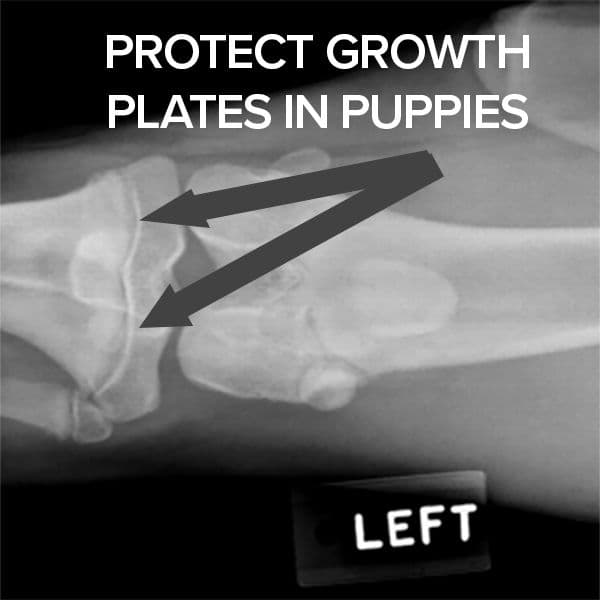
Learn what puppy growth plates are, when they close, and how injury risk and development affect long-term joint health throughout life
Protecting Your Puppy’s Growth Plates
Too much exercise can affect a growing puppy, placing stress on developing bones and increasing the risk of injury. Because puppies are still developing, early physical stress may influence long-term movement, joint health, and overall quality of life.
Understanding how growth plates function provides a clearer picture of why early development matters. Early development is shaped by rapid physical changes, particularly during the first months of life. For more context on this stage, see New Puppy Physical Development 8–16 Weeks.
What Are Growth Plates in Puppies?
Growth plates (also called epiphyseal plates) are areas of soft cartilage located near the ends of long bones. These structures are responsible for bone lengthening during development and remain open while a puppy is growing.
Unlike fully developed bone, this cartilage is softer and more vulnerable to Unlike fully developed bone, this cartilage is softer and more vulnerable to stress. As a result, these areas are more susceptible to injury during periods of rapid growth.
Growth plates gradually harden and close as a dog reaches physical maturity. Until that point, they represent one of the most sensitive parts of the musculoskeletal system.
Why Puppy Growth Plates Are Vulnerable
During growth, a puppy’s skeletal system develops at a different pace than muscles, tendons, and coordination. This temporary imbalance can influence how force is distributed through the body.
Several factors contribute to increased vulnerability:
• Rapid growth phases
• Immature coordination
• Developing muscle support
📌Larger dogs, including breeds like Great Danes, Golden Retrievers, and German Shepherds, typically experience longer growth periods. Because their growth plates remain open for extended periods, they may be exposed to risk for a longer time.
How Exercise Affects Growth Plate Development
Movement is an essential part of development. It supports coordination, muscle development, and body awareness. However, not all forms of activity place the same type of stress on a growing body.
📌Higher-impact or repetitive stress may place greater load on developing structures. Examples include repeated jumping, extended running on hard surfaces, and sudden directional changes.
When this type of stress exceeds what the developing body can manage, it may increase the likelihood of injury or structural changes over time.
This does not mean activity should be avoided. Rather, it highlights the importance of understanding how different types of movement interact with development. For a broader perspective on how physical development evolves across different stages of life, see Dog Physical Development Across Life Stages.
When Do Growth Plates Close in Dogs?
The timing of growth plate closure varies depending on a dog’s expected adult size.
- Small dogs: approximately 6–12 months
- Medium dogs: approximately 9–14 months
- Large dogs: approximately 18–24 months
Larger dogs tend to grow for a longer period, which means their growth plates remain open—and vulnerable—for more time.
Because individual variation exists, a dog’s projected adult size often provides a more reliable reference
When Do Puppies Stop Growing?
📌Puppies do not all grow at the same rate. Growth depends on factors such as genetics, size category, and overall development patterns.
In mixed-breed dogs, estimating expected adult size can help provide a general framework for understanding development timelines. However, variation is normal.
Observing changes in body proportions, coordination, and movement quality can provide additional context during this phase.
Signs of Growth Plate Injury in Puppies
Changes in movement are often the first noticeable sign that something may be affecting a puppy’s developing body.
Possible indicators include:
- Limping or favoring a leg
- Changes in gait or stride
- Reluctance to move
- Sensitivity in a specific limb
These signs do not always indicate a growth plate injury, but they suggest that the body may be under stress.
Understanding Growth Plate Injuries and Recovery
When a growth plate is affected, the body’s response can vary depending on the location and severity. In some cases, healing may occur with minimal long-term impact. In others, changes in bone development may influence alignment or joint mechanics over time.
Management approaches may include veterinary evaluation, temporary changes in activity, and supportive care.
Growth, Development, and Long-Term Joint Health
Early development plays a role in shaping how a dog moves throughout life. Repeated stress during growth does not always lead to visible injury, but it may influence how joints and tissues adapt over time.
⚠️Developmental factors, including structural stress and growth patterns, are associated with long-term joint health. These influences may contribute to reduced mobility or joint discomfort later in life.
Conclusion
Growth plates are a central part of a puppy’s development, allowing bones to lengthen and mature over time. Because they remain soft during this stage, they are more sensitive to stress compared to fully developed bone.
Recognizing how development, movement, and physical stress interact supports more informed observation during a puppy’s growth phase and helps frame long-term well-being.
References
- 📄 [1]Lewis, Georgia (2019). Musculoskeletal Development of the Puppy: Birth to Twelve Months. Animal Therapy Magazine.✓
- 📄 [2]Prieur, W. D. (1989). Management of growth plate injuries in puppies and kittens. Journal of Small Animal Practice, 30(11).✓
- 📄 [3]Yamasaki, Kanji & (1995). Histologic Study of the Femoral Growth Plate in Beagle Dogs. Toxicologic Pathology, 23(5).✓
- 📄 [4]Teunissen, M., Riemers, F. M., van Leenen, D., Groot Koerkamp, M. J. A., Meij, B.P , Alblas, J., Penning, L.C., Miranda-Bedate, A., & Tryfonidou. M. A. (2018). Growth Plate Expression Profiling: Large and Small Breed Dogs Provide New Insights in Endochondral Bone Formation. Journal of Orthopaedic Research, 36(1).✓
- 📄 [5]Nap, R. C. & Hazewinkel, H. A. (1994). Growth and Skeletal Development in the Dog in Relation to Nutrition; a Review. Veterinary Quarterly , 16(1).✓